
September 19, 1783: The Montgolfier Brothers’ Historic Balloon Flight at Versailles
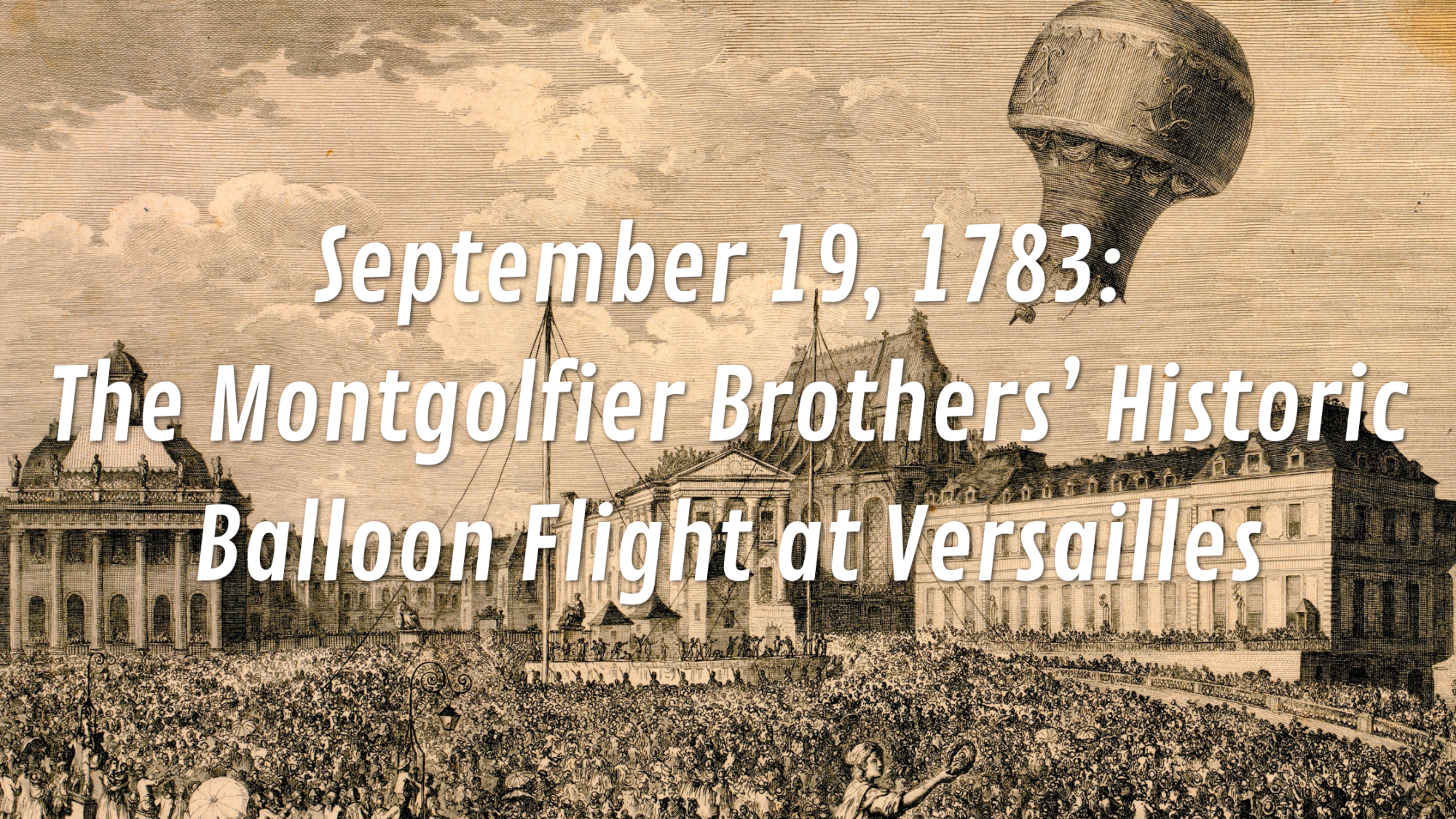
On September 19, 1783, an extraordinary scene unfolded at the Palace of Versailles outside Paris. Before King Louis XVI, the French royal family, members of the court, foreign dignitaries, scientists, and an enormous crowd of spectators, a remarkable aircraft began to rise into the sky.
Its passengers were equally remarkable.
Inside a wicker basket suspended beneath the balloon were a sheep, a duck, and a rooster.
The experiment organized by the Montgolfier brothers, Joseph-Michel and Jacques-Étienne Montgolfier, became one of the defining moments in the history of ballooning and human flight. The animals survived their journey, providing crucial evidence that living creatures could endure an ascent into the atmosphere. Only two months later, humans would make the historic leap themselves.
When we trace the development of balloon flight, September 19, 1783 stands as one of the most important dates in aviation history. It was the day an ambitious scientific experiment at Versailles helped turn humanity’s centuries-old dream of flight into reality.
The Montgolfier Brothers and the Beginning of Hot Air Ballooning
The story began with two brothers from Annonay in the Ardèche region of France.
Joseph-Michel Montgolfier and Jacques-Étienne Montgolfier belonged to a family involved in paper manufacturing. By 1782, the brothers were experimenting with the possibility of creating a lightweight vessel that could rise through the atmosphere.
Their experiments involved filling fabric envelopes with heated air produced by fires. At the time, the science behind why the balloon rose was not yet fully understood, but the brothers had discovered an idea powerful enough to change history.
On June 4, 1783, the Montgolfiers publicly demonstrated a large unmanned balloon at Annonay. The achievement quickly attracted widespread attention, including interest from the Académie Royale des Sciences, France’s prestigious Royal Academy of Sciences. The brothers were encouraged to demonstrate their invention closer to Paris and the royal court.
France was about to become the center of a new technological revolution.
Why the September 19, 1783 Flight Took Place at Versailles
By September, excitement surrounding balloons had spread throughout France.
The demonstration at Versailles would place the Montgolfiers’ invention before some of the most influential people in Europe.
The flight occurred in the presence of Louis XVI and the royal family, while the palace grounds filled with spectators eager to witness something that, until that year, had largely belonged to imagination.
The setting mattered.
Versailles was not simply a royal residence. It was one of the great political and cultural centers of eighteenth-century Europe. A successful balloon ascent there would instantly attract international attention.
The Palace of Versailles describes September 19, 1783 as a key date in human history, connecting the Montgolfiers’ experiment with humanity’s long-standing ambition to leave the ground and travel through the air.
And the balloon itself was designed to make an impression.
Le Réveillon: The Magnificent Montgolfier Balloon
The balloon prepared for the Versailles demonstration was known as Le Réveillon, named after Jean-Baptiste Réveillon, director of a royal wallpaper and decorated-paper manufactory and a collaborator in the balloon’s elaborate design.
This was hardly a plain scientific aircraft.
The enormous balloon was approximately 18.47 meters tall and 13.28 meters wide, weighing about 400 kilograms. It was constructed from cotton canvas with paper applied to its surfaces.
Its appearance reflected the grandeur of Versailles.
Against a sky-blue background were elaborate golden decorations, including the king’s royal cipher of two intertwined letter Ls.
Creating the balloon had not been easy. Shortly before the royal demonstration, the envelope was damaged and required rapid reconstruction and repair. Nevertheless, Étienne Montgolfier and his collaborators succeeded in preparing the balloon for the highly anticipated experiment.
But one major question remained unanswered.
Could a living creature survive balloon flight?
Why a Sheep, Duck and Rooster Were Chosen
Before sending humans into the atmosphere, the experimenters needed evidence that living passengers could survive the journey.
The solution was one of the most memorable passenger lists in aviation history:
- A sheep
- A duck
- A rooster
The three animals were placed inside a round wicker basket suspended beneath the balloon.
Their selection provided an opportunity to observe how different animals responded to the experience.
The sheep was a land animal whose physiology was considered useful for comparison with humans. The duck naturally experienced altitude through flight and therefore provided a different reference point. The rooster, although a bird, did not normally fly at significant elevations for sustained periods.
What sounds unusual today represented a serious scientific question in 1783.
Humans had never traveled to such heights in an aircraft. No one could be certain what prolonged elevation above the ground would do to a person.
Before risking a human life, the animals would go first.
The Historic Balloon Launch on September 19, 1783
At approximately 1:00 p.m., a cannon blast signaled the beginning of the demonstration.
The sheep, duck and rooster were placed into their wicker basket.
Eleven minutes later, another cannon sounded.
The balloon was released.
Before the astonished spectators at Versailles, the enormous decorated craft rose from the ground and climbed into the sky.
According to the Palace of Versailles, the balloon reached approximately 600 meters above the ground. It remained airborne for roughly eight minutes, traveling about 3.5 kilometers before descending in the Wood of Vaucresson.
For those watching from Versailles, it was an almost unimaginable sight.
Throughout recorded history, humans had watched birds cross the sky. Inventors, philosophers and artists had imagined machines capable of carrying living beings into the air.
Now, before the king of France and thousands of witnesses, it was actually happening.
A man-made craft carrying living passengers was floating above the French countryside.
Did the Sheep, Duck and Rooster Survive the Balloon Flight?
Yes.
All three animals survived.
After the balloon landed, Pilâtre de Rozier, a scientist and one of the men who would soon become a pioneering human aeronaut, hurried to examine the passengers.
The sheep, duck and rooster had survived their journey through the sky. The Smithsonian’s National Air and Space Museum notes that their survival helped demonstrate that balloon flight could potentially be safe for human passengers.
The animals quickly became celebrated figures in the ballooning story.
Louis XVI reportedly rewarded the remarkable passengers with a place in the menagerie at Versailles.
Their flight had accomplished something far larger than an entertaining spectacle.
It had cleared one of the final psychological and experimental barriers standing between humans and the sky.
The Versailles Experiment Paved the Way for Human Flight
The implications of the September 19 experiment were immediate.
If living creatures could travel aboard a balloon and return safely, the obvious question became:
Could humans do the same?
There would not be long to wait.
Experiments with human passengers progressed rapidly during the autumn of 1783, culminating in an achievement that changed transportation forever.
On November 21, 1783, just over two months after the Versailles animal flight, Jean-François Pilâtre de Rozier and François Laurent, Marquis d’Arlandes, made the first historic free flight carrying human beings in a Montgolfier balloon.
The Smithsonian’s National Air and Space Museum identifies their November 21 journey as the first free flight by human beings.
The progression was astonishingly fast.
In June 1783, the Montgolfiers demonstrated their balloon publicly at Annonay.
By September, animals were flying over Versailles.
By November, humans were flying freely through the sky.
In less than six months, an experimental idea had opened an entirely new era of human exploration.
1783: The Year Ballooning Changed the World
The Montgolfier brothers were not working in isolation.
The year 1783 became an extraordinary period of experimentation with lighter-than-air flight.
On August 27, 1783, physicist Jacques Alexandre-César Charles launched a small hydrogen balloon from the Champ de Mars in Paris, near the location where the Eiffel Tower would eventually stand.
Then came the Montgolfiers’ animal flight at Versailles on September 19.
Then Pilâtre de Rozier and the Marquis d’Arlandes completed their human free flight on November 21.
Finally, on December 1, 1783, Jacques Charles and Nicolas-Louis Robert completed a free human flight in a hydrogen balloon.
Balloon technology was advancing at extraordinary speed, and enormous crowds gathered to witness these experiments. The Smithsonian describes the invention of ballooning as creating tremendous excitement throughout late-eighteenth-century France, with vast numbers of spectators gathering for major ascents.
The sky had suddenly become accessible.
Why September 19 Is an Important Date in Ballooning History
When we recognize important dates in aviation history, September 19 deserves special attention.
The Versailles experiment connected several critical milestones.
It demonstrated that a large balloon could successfully carry living passengers.
It showed that those passengers could survive an aerial journey.
It generated enormous public and royal interest in balloon technology.
Most importantly, it gave experimenters greater confidence to proceed toward human balloon flight.
The significance was understood almost immediately. Images depicting the Versailles ascent circulated widely, helping news of the experiment spread beyond France and throughout Europe. The event became not merely a scientific demonstration but an international symbol of technological progress during the Age of Enlightenment.
From the Palace of Versailles to the Birth of Aviation
Today, flight is such a familiar part of everyday life that it can be difficult to imagine a world in which leaving the ground seemed impossible.
Aircraft cross oceans in hours. Helicopters hover above cities. Rockets carry astronauts beyond Earth’s atmosphere.
But every chapter in aviation history has an earlier chapter.
For lighter-than-air flight, one of those chapters was written above Versailles.
The sheep, duck and rooster carried beneath Le Réveillon were not simply unusual passengers in an eighteenth-century spectacle. Their journey formed part of a carefully observed experiment that brought humanity closer to answering one of its oldest questions:
Can we fly?
On September 19, 1783, the answer became increasingly clear.
Yes.
The Lasting Legacy of the Montgolfier Brothers
The Montgolfier brothers helped launch what the Smithsonian describes as the beginning of the air age. Their experiments transformed the balloon from an intriguing concept into a practical vehicle capable of carrying living creatures and, shortly afterward, human beings.
Their influence can still be felt every time a balloon rises into the sky.
Modern ballooning has evolved dramatically since 1783. Materials, burners, navigation techniques, safety systems and scientific understanding have advanced beyond anything Joseph and Étienne Montgolfier could have imagined.
Yet the fundamental experience remains connected to those pioneering experiments: the extraordinary sensation of rising above the landscape and seeing the world from an entirely different perspective.
More than two centuries after the Montgolfier brothers’ experiments, balloons continue to inspire the same instinct that drew enormous crowds to Versailles—the desire to look upward, leave the familiar ground behind and experience the world from the sky.
Frequently Asked Questions About the September 19, 1783 Balloon Flight
When did the Montgolfier brothers fly the sheep, duck and rooster?
The historic animal balloon flight took place on September 19, 1783, at the Palace of Versailles in France.
What animals were aboard the Montgolfier balloon?
The balloon carried a sheep, a duck and a rooster in a wicker basket suspended beneath the aircraft.
Were Louis XVI and Marie Antoinette present for the balloon flight?
The demonstration took place before King Louis XVI and the royal family, along with members of the court and a large crowd of spectators at Versailles. Historical depictions and Smithsonian records also confirm the royal family’s presence at the launch.
Did the animals survive the first balloon flight?
Yes. The sheep, duck and rooster all survived, providing important evidence that living creatures could endure balloon flight.
How high did the Montgolfier balloon fly at Versailles?
According to the Palace of Versailles, the balloon climbed to approximately 600 meters before descending.
How long did the September 19, 1783 balloon flight last?
The balloon remained airborne for approximately eight minutes and traveled roughly 3.5 kilometers before landing near Vaucresson.
When was the first human hot-air balloon flight?
The first free human balloon flight followed on November 21, 1783, when Pilâtre de Rozier and the Marquis d’Arlandes flew aboard a Montgolfier balloon.
September 19, 1783: The Day the Dream of Human Flight Came Closer to Reality
When we look back at the history of hot-air balloons, September 19, 1783 represents far more than an unusual story about three animals floating above Versailles.
It represents a turning point.
Before an immense crowd and the French royal court, the Montgolfier brothers launched a balloon carrying a sheep, duck and rooster into the sky. The balloon rose hundreds of meters above the landscape, traveled several kilometers and returned its passengers safely to the ground.
Within weeks, humans would follow them.
The experiment at the Palace of Versailles helped transform flight from a centuries-old dream into an achievable reality. More than 240 years later, the sight of a balloon rising into the sky still connects us with that remarkable era of experimentation, discovery and imagination.
And every September 19, we can remember three unlikely pioneers—a sheep, a duck and a rooster—whose brief journey above Versailles helped open the sky to humanity.
Experience the Wonder of Balloon Flight for Yourself
More than 240 years after the Montgolfier brothers helped introduce the world to balloon flight, the excitement of rising above the landscape still captures the imagination.
Today, visitors to Niagara Falls, New York can experience that sense of wonder aboard the LIVE! On Air Fallsview Balloon Ride. Ascend above Niagara Falls for unforgettable panoramic views of the Falls, Niagara River, surrounding parkland and skyline from a completely different perspective.
From the pioneering balloon flights of 1783 to the unforgettable aerial experiences of today, the fascination with seeing the world from above continues.